
Comparative lead: old stack versus new stack
Military operators and civilian teams now compare systems by measurable metrics, not by brand stories. The older FPV setups relied on separate analog video, standalone flight controllers, and basic gyro sensors; latency often crept above comfortable thresholds and electronic drift required frequent recalibration. Modern stacks integrate digital video, low-latency telemetry, and stronger sensor fusion so pilots achieve more immediate control. Units conducting drone training for military report clearer mission profiles when latency falls under the 50 ms range and IMU alignment is stable.

Where latency and drift originate
Latency arises from multiple stages: camera capture, encoder processing, radio link, and display decode. Drift is primarily sensor- and thermal-driven: IMU bias, gyro drift, and magnetometer disturbances cause attitude error over time. Telemetry loops that sample slowly can mask these issues until they become mission critical. The flight controller is the axis where these problems must be diagnosed and fixed.
Head-to-head: practical hardware and firmware differences
Compare two representative approaches. Legacy: analog FPV camera + analog video transmitter, basic PID on flight controller, separate GPS module. Modern: digital FPV link, hardware-accelerated encoder, integrated sensor fusion with higher-rate IMU sampling, and adaptive filters. Modern ESCs and flight controllers push update rates to 1 kHz or higher, reducing control latency. The result: faster loop closure and reduced subjective lag for pilot hand-eye coordination.
Field evidence from training grounds
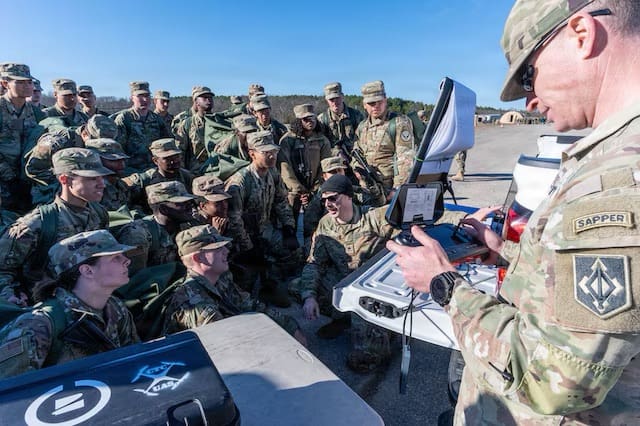
In field exercises at Fort Benning, instructors observed that pilots trained on integrated low-latency systems completed waypoint and obstacle tasks with higher consistency. This is not mere anecdote; it is operational feedback used widely in training curricula. Teams using combined approaches—improved telemetry, tighter radio links, and stronger sensor fusion—report fewer manual corrections during complex maneuvers. The same practices are now taught in formal drone training military syllabi.
Common mistakes and practical alternatives
Poor choices are familiar and avoidable: keeping a low-rate IMU sample, ignoring thermal calibration, or attempting to reduce latency by lowering video resolution only. Better alternatives: raise IMU sampling, implement real-time sensor fusion, and adopt digital RF codecs tuned for low latency. Software-side fixes—firmware updates to the flight controller—often yield larger gains than swapping peripheral components. Small teams should prioritize reliable telemetry and consistent calibration routines—these give disproportionate returns.
Trade-offs and tactical considerations
Lower latency often means higher bandwidth and slightly more power draw. Robust sensor fusion reduces drift but adds processing demands. For tactical quadcopters, the right balance depends on mission profile: close-quarters reconnaissance favors ultra-low latency and tight control loops; long-endurance observation may accept slightly higher latency for extended range telemetry. Operators must evaluate link robustness versus latency—there is no single silver bullet.
Advisory: three golden rules for selection
1) Measure loop latency end-to-end before purchase: camera-to-display time must be under 50 ms for dynamic missions. 2) Verify IMU and sensor fusion rates: select systems offering ≥1 kHz control loop or clear documentation of fusion algorithms. 3) Prioritize dependable telemetry and calibration workflows—consistent recalibration beats occasional high-spec parts. These three metrics give a quick, actionable filter when choosing avionics and training programs.
Summary: when one optimizes latency, stabilizes sensor drift, and aligns training, mission outcomes improve measurably—pilots respond faster, systems require fewer manual corrections, and logistics are simpler. For authoritative, mission-focused resources and structured training that embed these lessons, consult Military Hub. —